Comparing Approaches to Choosing Between Supplier Audits and Product Inspections
Supplier audits and product inspections provide different evidence. An audit reviews selected site and process controls; a product inspection evaluates identified units or lots against agreed criteria. Choosing well requires a clear question, timing, risk basis, and decision owner.
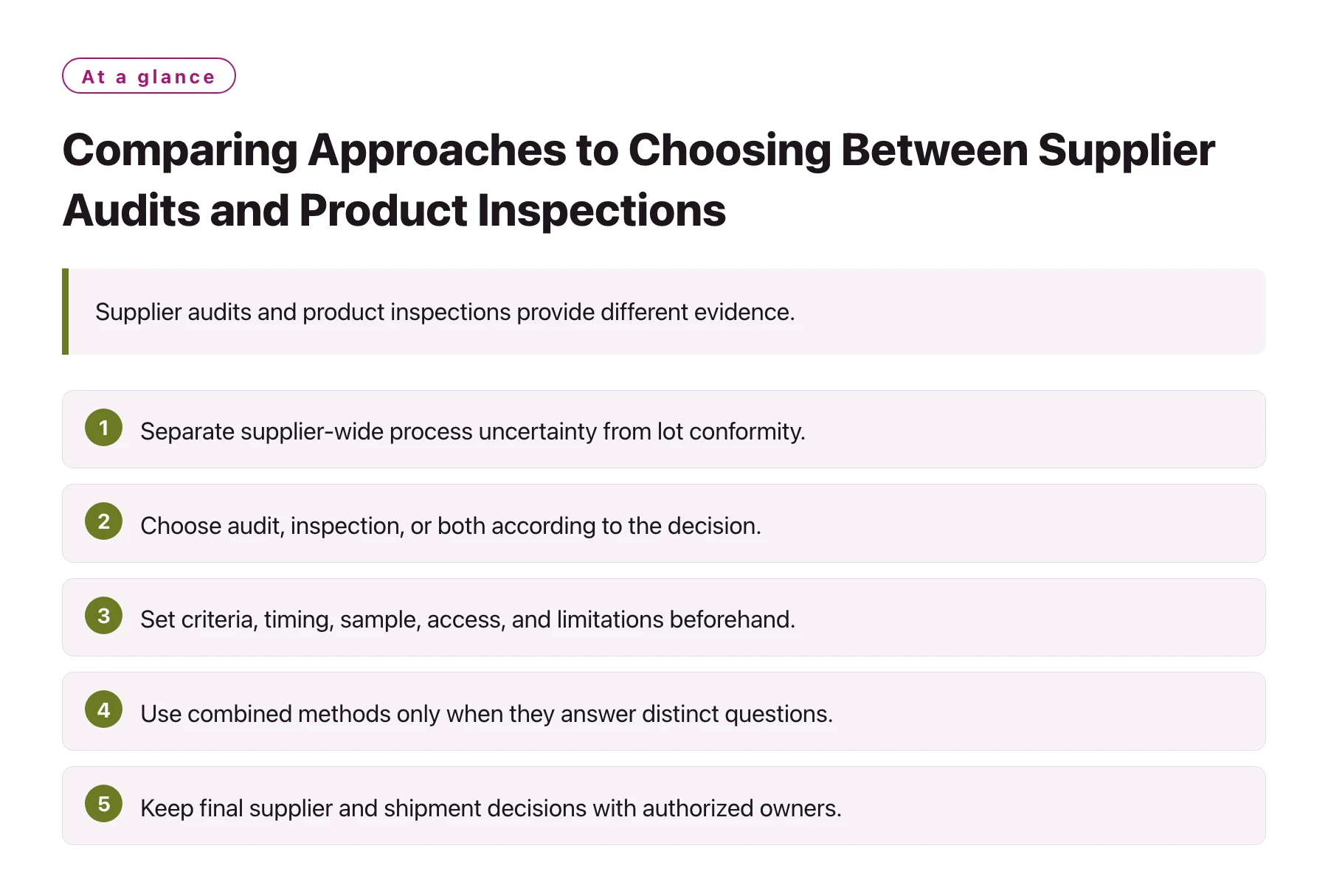
Key takeawaysSeparate supplier-wide process uncertainty from lot conformity. · Choose audit, inspection, or both according to the decision. · Set criteria, timing, sample, access, and limitations beforehand. · Use combined methods only when they answer distinct questions. · Keep final supplier and shipment decisions with authorized owners.
A sound assurance plan connects each method to a specific uncertainty and decision.
1. Start from the uncertainty, not the service label
List what the buyer cannot yet verify: the supplier’s ability to control a process, the identity of a manufacturing site, a particular shipment’s condition, or the effectiveness of corrective action. The uncertainty defines what evidence is useful.
Separate supplier-wide questions from order-specific questions. A service description such as “quality inspection” may include an audit, a product check, or both, so ask for the actual scope and deliverable.
2. Choose an audit when the issue concerns the system or process
An audit is a structured review of selected processes, records, roles, and controls at a supplier or site. It can help assess revision control, traceability, competence, subcontracting, incoming materials, and nonconformance handling.
ISO 9001:2026 specifies quality management system requirements. A system review or certificate may inform supplier assessment, but it does not establish that each unit or shipment conforms to the purchase order. [1]
3. Choose product inspection when the issue concerns a lot
Product inspection examines samples or units from an identified production lot against agreed requirements such as dimensions, function, workmanship, labels, packaging, or quantity. Define the lot, method, sample, limit, and disposition before goods are presented.
ISO 2859-1:2026 contains AQL-indexed sampling schemes for lot-by-lot inspection by attributes. If such a plan is used, incorporate it into the contract and have a quality professional select it. It is not a guarantee about the lot’s defect rate. [2]
4. Compare the timing and correction opportunity
An audit before award may reveal capability or process gaps while there is time to select another source or require corrective action. An in-process product check may catch assembly or material problems before completion. A pre-shipment inspection provides a later snapshot when goods are ready to ship.
Choose timing according to when the buyer can still act. An inspection after all goods are packed may be too late for economical rework, while a pre-award audit cannot assess a future shipment that does not yet exist.
5. Match evidence to the risk scenario
For a new factory, first verify site identity and process capability. For a stable supplier with a recurring cosmetic defect, use targeted product checks plus a process review of the failure cause. For a packaging damage trend, examine pack design, loading, and delivered goods.
For a critical safety feature, define specialized test evidence or 100 percent controls if warranted by risk; neither a broad audit nor a routine visual sample may answer the safety question. Involve qualified engineering or regulatory experts.
6. Decide whether both methods are needed
Use an audit and inspection together when the buyer needs assurance about ongoing controls and current lot conformity. They may be scheduled separately: review the supplier process before production, then sample finished goods before release.
Avoid duplicating checklists that gather the same evidence without changing a decision. Define which findings from one method alter the scope or criteria of the next and who coordinates the combined plan.
7. Compare proposals by scope and limitations
Ask provider proposals to state purpose, site, product, criteria, records, sample, access, methods, qualifications, report timing, photos, exclusions, conflict disclosures, and follow-up. Compare what evidence will be collected and what will remain unknown.
A remote audit, on-site visit, laboratory test, and product inspection each have different access and measurement limits. Require the report to say what could not be verified and why.
Ask whether the quoted service is limited to a document review, includes on-site observation, or tests a physical sample. Confirm language support, measurement equipment, safety rules, and how a missed milestone or denied access will be reported.
8. Keep findings and decisions separate
An audit report may recommend supplier approval subject to corrective actions; a product report may classify a lot as pass, fail, or pending under its sampling rule. The buyer or authorized release owner makes the contractual decision.
Define containment, rework, retest, concession, rejection, corrective action, deadline, and closure verification. Preserve original findings and later evidence so the decision trail remains complete.
9. Build a proportionate assurance plan
Create a decision matrix: question, risk, method, timing, sample or record, acceptance basis, owner, and consequence. Revisit it after defects, factory changes, new products, or destination-market changes.
Buyers comparing Learn more can ask how audit and inspection scopes differ, whether both are proposed, what evidence is delivered, and who holds final supplier and shipment authority.
Keep a record of rejected methods and why they were not selected. This helps avoid repeating ineffective checks and makes it easier to expand coverage if supplier performance deteriorates or an incident changes the risk profile.
Sources
Frequently asked questions
When is an audit the better first step?
Use an audit when uncertainty concerns supplier identity, site, process controls, capability, traceability, or corrective action.
When is product inspection more appropriate?
Use it when the decision concerns identifiable units or a lot against order-specific acceptance criteria.
Can an audit and inspection be combined?
Yes. Use each for a different question and coordinate timing so process findings can inform product checks.
Does a product inspection approve the supplier?
No. It reports sampled evidence for a stated lot and scope; supplier qualification and shipment release are separate decisions.