Is a Yearly Plan Worth It for Occasional Use?
For a light reader the real question is not which plan but how much time you actually spend: sixteen sessions a month at half an hour each is 8.0 hours, while a genuinely occasional four sessions a month at the same length is 2.0 hours. Deciding on the strength of the second figure rather than the first is what keeps a commitment proportionate.
Key takeaways
- Measure the habit before the plan: sessions per week × minutes per session is your monthly hours.
- A four-session month is 2.0 hours at thirty minutes each — one quarter of the sixteen-session reference month.
- Occasional use is defined by gaps, not by totals: a habit with two empty weeks a month does not need a long commitment.
- Read the plan page and the search page first. Understanding your own usage pattern matters more than any comparison table.
Define occasional before comparing anything
Occasional use covers two very different readers. The first opens a chat once or twice a month in a burst and does not think about it in between. The second uses the platform most weeks but for short windows, ten or fifteen minutes at a time. Both would describe themselves as light users, and their monthly hours differ by a factor of four.
The distinction matters because the value of any longer commitment depends on whether the habit is continuous. A reader with two empty weeks a month is not getting a quarter of the use out of a month — they are getting a habit that could be paused without any loss at all, which is exactly the case a shorter commitment serves better.
Build the break-even in hours, not in money
Prices are not the useful variable here because they change; the structure of the decision is what stays stable. What you are really asking is whether the hours you will realistically use justify committing in advance, and that is arithmetic you can do from your own log.
Count three things for a fortnight: how many sessions you open, how long the average session runs, and how many days you do not open the platform at all. The third number is the one most readers never check, and it is the decisive one, because a long commitment is designed for continuous habits and a habit with gaps is being asked to pay for continuity it does not use.
| Reader profile | Sessions and length | Monthly hours |
|---|---|---|
| Regular, long sessions | 16 sessions at 60 minutes | 16.0 hours |
| Regular, medium sessions | 16 sessions at 30 minutes | 8.0 hours |
| Regular, short sessions | 16 sessions at 15 minutes | 4.0 hours |
| Occasional, medium sessions | 4 sessions at 30 minutes | 2.0 hours |
| Occasional, short sessions | 4 sessions at 15 minutes | 1.0 hour |
Worked example
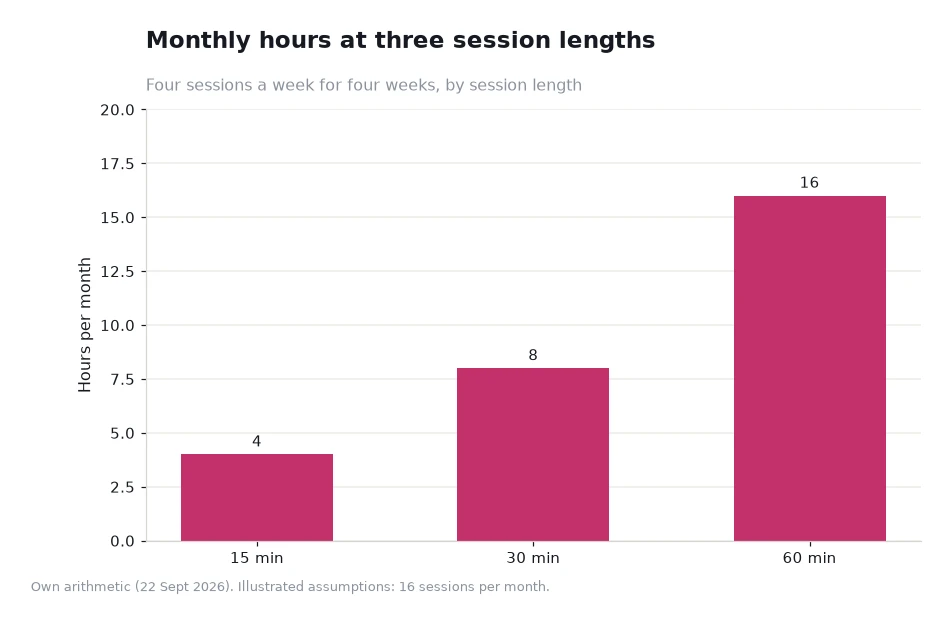
Take the reference month the chart uses: sixteen sessions, which is four a week across four weeks. Fifteen minutes per session gives 4.0 hours; thirty minutes gives 8.0 hours; a full hour gives 16.0 hours, roughly 3.7 hours a week.
Now scale it down to genuinely occasional use. Four sessions a month at thirty minutes each is 2.0 hours — one quarter of the 8.0-hour bar and one eighth of the 16.0-hour bar. The comparison is not close: an occasional reader's month is a fifth of a fortnight of a heavy reader's habit. If your own fortnightly log shows four or five sessions in total, you are in the bottom half of that table, and the arithmetic argues for keeping your options open rather than locking in a longer commitment that assumes the top half.
What to check on the plan page
Read the unlimited plan page with your own two numbers in hand: monthly hours and the number of empty sessions per week. Then ask two questions. Does the commitment assume a rhythm you actually have? And if your usage halves for two months, would the decision still look sensible in hindsight?
If the answer to either is no, the short commitment is the better instrument, and it is not a lesser choice — it is simply matched to the habit. A reader who uses 2.0 hours a month and keeps a flexible arrangement is getting exactly what they paid attention to, while a reader on a long commitment who uses the platform twice in a quarter has bought continuity they did not use.
Making occasional use satisfying anyway
Light use has its own discipline, and it is mostly about not wasting the setup. Save two or three characters rather than accumulating a list, because a short list is fully reviewable in the five minutes you have. Keep the same few cards rather than auditioning new ones each session, since continuity is what makes a fifteen-minute window feel like part of something.
Use character search when you do have a longer window, so an occasional session is spent writing rather than browsing, and read the platform's own description at porn ai chat once before deciding anything — the FAQ entry on what Porn Chat AI means describes the format in a paragraph, which is enough to judge whether your occasional use is likely to grow into more. If it does grow, revisit the question then, with three months of your own log rather than a guess.
One behavioural point is worth more than any comparison. A longer commitment encourages a reader to use the service more in the first weeks and then less, because the sense of having already decided removes the nudge that comes from choosing each month. If you notice that pattern in your own log — a busy first fortnight and a quiet third week — the honest reading is that your usage is driven by interest rather than by arrangement, and interest is best served by keeping the arrangement light. Crushon's own plan page simply describes what the product offers; it cannot tell you how often you will want it.
Set a review date either way. Whether you choose a longer commitment or stay flexible, look at your log again after three months and ask the same two questions: does the rhythm match, and would the decision look sensible if usage halved? Habits change more than readers expect, and a decision that is revisited is a decision that stays proportionate.
Frequently asked questions
How do I know whether I am a light user?
Look at the empty days, not the busy ones. If two weeks a month pass with no session at all, the habit is occasional regardless of how long the sessions are.
Should occasional readers keep a saved list at all?
Yes, but a short one. Two or three cards you return to will be used; a long list will not be reviewed often enough to justify itself.
Does a longer commitment make sessions better?
No. Session quality depends on the characters you use and how you write, not on the length of the arrangement you chose.
Match the commitment to the calendar
Log sessions and minutes for a fortnight, count the empty days, and compare your month against the table above. If your total sits near 2.0 hours with gaps between sessions, keep your options open and spend the effort on two good characters instead. Revisit the decision when the habit itself changes, which is the only signal worth acting on.
Notes: hourly figures are illustrative arithmetic, and the platform pages referenced[1] were read 22 Sept 2026. Read 22 Sept 2026. Written for adult readers aged 18 and above.