Which beer brewing equipment Is Essential for Commercial Production?
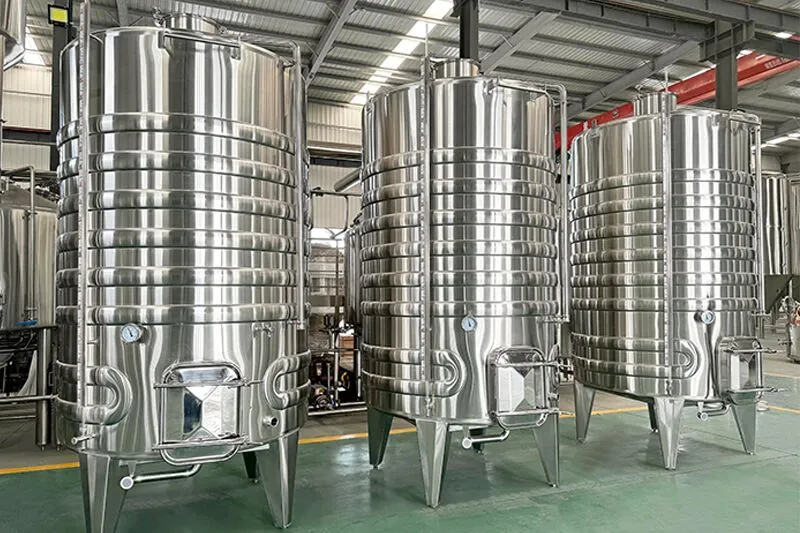
A commercial brewery normally needs a malt mill, mash/lauter equipment, kettle, whirlpool, hot-liquor tank, plate heat exchanger, fermentation tanks, glycol chiller, sanitary pumps, CIP system, CO₂ supply, and packaging equipment. A 20 hL brewhouse running three turns can produce about 60 hL of wort in one brewing day, while a beer held for 14–21 days may require 140–210 hL of cellar space at only 100 hL weekly production. Equipment should therefore be sized around daily turns, tank occupancy, cooling demand, cleaning time, and packaging rate rather than brewhouse volume alone. One undersized utility can limit the output of an otherwise well-sized brewery.
Commercial brewing starts with malt handling because brewhouse consistency depends partly on how uniformly grain is crushed. A two-roller mill may suit a small production brewery, while four- or six-roller designs provide more control over husk preservation and particle size when throughput rises. A 20 hL batch using 350–500 kg of malt requires a mill and conveyor system able to prepare the grist without extending the brewing schedule.
Milling connects directly to mash performance. Excess flour can slow lautering, while large intact kernels leave extract unused, so breweries usually judge milling by the distribution of husk, coarse grits, fine grits, and flour rather than by mill speed alone. Even a 2–3% change in extract recovery becomes material when hundreds of tonnes of malt are processed each year.
The grist then enters the brewhouse, where vessel arrangement affects the number of batches that can be produced in one shift. A two-vessel system combines several operations and uses less floor space, while a four-vessel system can separate mashing, lautering, boiling, and whirlpooling so another batch starts before the previous one has completed every stage.
For example, a 20 hL brewhouse completing one turn in 7 hours produces far less daily volume than the same nominal 20 hL brewhouse designed for three turns in 10–12 hours. Vessel count, transfer time, heating rate, lautering duration, and cleaning time therefore need to be reviewed together rather than comparing systems only by the number printed on the tank.
A 20 hL brewhouse making three batches delivers roughly 6,000 L of wort before cellar and packaging losses. If fermentation and conditioning take 18 days, the brewery needs enough available tank volume to keep repeated brewing days from competing for the same fermenters.
Mash vessels must provide controlled mixing and heating without creating large temperature differences inside the grain bed. Steam jackets are common in commercial systems because they can transfer heat over a large surface area, while insulation reduces heat loss during rests that may last 20–60 minutes depending on the recipe.
Lautering follows mashing, so false-bottom open area, rake design, sparging coverage, grain-bed depth, and wort collection matter more than tank capacity by itself. A brewery recovering 78% brewhouse efficiency instead of 75% obtains about 4% more extract from the same malt input, which can change annual raw-material consumption noticeably at commercial scale.
Boiling then places a large demand on the brewery’s heating system. A commercial kettle must reach boil at a rate compatible with the production schedule and maintain enough circulation for uniform heating. Depending on process design, evaporation during a 60–90 minute boil may remove several percent of the wort volume, so kettle gross volume must leave headspace above the normal working volume.
The whirlpool receives hot wort after the boil and separates hop particles and coagulated material before cooling. Tangential inlet placement, vessel diameter, inlet velocity, and settling time affect how tightly solids collect near the center. Poor separation sends more material toward the heat exchanger and fermenter, increasing product loss and cleaning work downstream.
Hot-side equipment cannot run efficiently without enough brewing water. A commercial hot-liquor tank supplies mash water, sparge water, and hot water for other process needs; many systems size it at roughly 1.5–2 times the brewhouse working volume, although brewing schedule and heat recovery determine the final requirement.
Water use extends beyond the recipe. Brewers Association resources note that breweries without effective water-conservation programs can use more than 10 gallons of water for each gallon of beer produced, because tank cleaning, floor cleaning, packaging, cooling, and rinsing consume water outside the finished product.
A plate heat exchanger links the hot side to fermentation. Wort entering near boiling temperature may need to reach roughly 8–12°C for many lager fermentations or around 17–22°C for many ale processes, so incoming water temperature, coolant temperature, plate area, flow rate, and required knockout time need to be specified before selecting the unit.
Consider 2,000 L of wort. Cooling it in 40 minutes requires an average wort flow of 50 L/min; cooling the same batch in 80 minutes cuts effective transfer throughput in half and keeps the whirlpool occupied twice as long. A heat exchanger that reaches the desired outlet temperature but does so too slowly still limits production.
Fermentation tanks usually occupy more capital and floor space than hot-side vessels because beer stays in them much longer. A 20 hL brew may occupy a fermenter for 10–14 days for a fast ale, while lagering, dry hopping, maturation, or extended conditioning can push tank residence toward 21 days or longer.
For a brewery producing 100 hL per week with an average 3-week tank cycle, approximately 300 hL of working fermentation capacity can be occupied before adding cleaning intervals or scheduling space. Filling 40 hL fermenters with two 20 hL brews can reduce tank count, but it requires repeatable brewing on consecutive turns and suitable wort-transfer scheduling.
| Equipment area | Practical sizing reference | Production issue if undersized |
|---|---|---|
| Brewhouse | Batch volume × planned daily turns | Fewer brews per shift |
| Fermenters | Weekly output × 2–4 weeks | No tank available for wort |
| Hot-liquor tank | Often 1.5–2× brew length | Waiting for hot water |
| Heat exchanger | Full knockout within planned transfer window | Longer vessel occupancy |
| Packaging line | At or above weekly packaging requirement | Finished beer waits in tanks |
| Glycol system | Peak simultaneous cooling demand | Slow pull-down or unstable tank temperature |
Fermenters also depend on refrigeration. Fermentation produces heat while the brewery may simultaneously need to cool fresh wort, crash one tank toward 0–2°C, and maintain several other vessels at controlled temperatures. Chiller selection therefore has to account for coincident demand, ambient heat gain, piping losses, coolant temperature, and tank insulation rather than summing vessel volume alone.
A brewery with six fermenters may only have two tanks at peak fermentation on one day, but another schedule can place four tanks under active cooling while a fifth is being cold-crashed. Adding 15–25% engineering allowance is common in utility planning, although the appropriate margin depends on climate, equipment design, production growth, and whether spare refrigeration capacity is available.
Sanitary piping and pumps connect every vessel. Product-contact stainless steel is normally selected for cleanability and corrosion resistance, while fittings, valve seats, hoses, and welds should avoid areas where beer or cleaning solution can remain after drainage. FDA food CGMP requirements under 21 CFR Part 117 cover sanitary operations, equipment, plant conditions, and process controls; the modernized CGMP framework was established in 2015.
Cleaning-in-place equipment deserves the same attention as brewing vessels because every fermentation tank may need a complete cleaning cycle before the next fill. A CIP arrangement can include caustic solution, acid treatment where appropriate, rinse water, pumps, spray devices, heat, return piping, and conductivity or concentration checks.
FDA guidance notes that food-contact surfaces must be cleaned as often as needed to protect food from contamination, and cleaning performance depends on chemistry, temperature, contact time, and physical removal of residues. A 30-minute step repeated across 10 tanks uses 5 production hours, so CIP flow and scheduling influence labor and tank availability as well as sanitation.
Tank size alone does not determine brewery capacity. A 40 hL fermenter unavailable because cleaning takes longer than planned contributes 0 hL to the next brewing day.
After fermentation, a bright beer tank can separate cellar scheduling from packaging. Beer may be transferred there for final carbonation, clarification, blending, quality checks, and packaging feed. A brewery packaging 40 hL during one shift can benefit from a bright tank that supplies the filler without tying up a fermentation vessel for the full packaging period.
Packaging equipment then has to match sales format. A keg-focused brewpub may need a keg washer and filler, while a distribution brewery may require a can depalletizer, rinser, filler, seamer, date coder, labeler, conveyors, and case packing. A line rated at 30 cans per minute theoretically processes 1,800 cans per hour, but stops, changeovers, cleaning, foam, and downstream handling reduce actual output.
Package quality also depends on oxygen management and closure control. In February 2026, the Brewers Association advised breweries to evaluate compatibility between each beer brand and its selected can because recent U.S. market withdrawals showed that not every beer is compatible with every can specification.
CO₂ equipment requires similar engineering attention. Breweries use carbon dioxide for carbonation, purging, pressure transfer, and packaging, yet escaped CO₂ can collect in low areas because it is heavier than air. OSHA’s current Table Z-1 lists an occupational exposure limit of 5,000 ppm as an 8-hour time-weighted average, so mechanical ventilation and fixed CO₂ detection are practical facility considerations.
Water treatment should be selected after laboratory analysis of the brewery’s actual supply. Carbon filtration may address chlorine, softening may reduce hardness for selected utility uses, and reverse osmosis can provide a lower-mineral starting point for recipe adjustment. A brewery changing source-water alkalinity by 20–30% without recipe adjustment can see measurable changes in mash pH and finished-beer consistency.
Instrumentation makes those processes easier to repeat. Temperature probes, pressure transmitters, flowmeters, load cells, conductivity meters, pH meters, dissolved-oxygen meters, and PLC records provide measurements that operators can compare between batches. A production brewery making 250 batches in a year gains much more from recorded process data than from relying on an operator’s memory of one previous brew.
The same approach applies when comparing Beer Brewing Equipment Manufacturers. Instead of comparing only vessel price and nominal volume, request heating rate, cooling capacity, pump curves, jacket area, insulation specification, working and gross tank volume, pressure rating, valve brands, weld documentation, electrical requirements, control architecture, CIP coverage, spare-parts availability, and commissioning scope.
For example, two 30 hL fermenters can have the same advertised capacity while differing in gross headspace, cooling-jacket area, allowable working pressure, cone geometry, insulation thickness, and port layout. A 10% difference in usable working volume across ten nominally identical tanks is equivalent to the capacity of an additional 30 hL tank.
Floor space and utilities should be checked before purchase orders are placed. Tank diameter determines whether equipment can pass through doors, ceiling height affects installation, and full vessel weight affects floor design. Thirty hectoliters of beer alone weighs roughly 3 metric tonnes before the stainless vessel, fittings, platforms, and connected piping are counted.
Electrical service, steam generation, drainage, glycol piping, water pressure, compressed air, ventilation, and wastewater handling must also support the selected production rate. A brewhouse capable of three turns in 2026 will not deliver three turns consistently when the boiler, hot-water supply, chiller, drains, or packaging equipment were sized around one turn per day.
Equipment specifications should therefore be checked against a weekly production model before fabrication. Put every brew, transfer, fermentation day, tank cleaning, cold crash, bright-tank transfer, and packaging run on a 7- to 21-day schedule; the first time two operations request the same vessel or utility at once, the plant layout or capacity needs another review.